Water is this unique medium that envelops you and seems to offer no resistance, that can carry you but cannot be held.
To hold it, a container is needed to give the water a shape and boundary, and then a second container to allow the water to flow from one to the other.
After the original whole-body experiences of ‘I am (again) inside and wonderfully enveloped and everything is one (as before my birth)‘, it makes new tactile and mental-emotional experiences with the outer world possible.
Now one cup is empty and sad. The other is full, and happy or proud, and is happy to pour something into the poor empty container.
Here we see how thinking and the first symbolic functions are born through empathy when the necessary external circumstances are present. For without a suitable container, water cannot be caught or an empty cup filled. Just as a hungry baby cannot be fed or comforted without an empathetic mother figure.
The shaping of the containers creates basic mental abilities:
1. own mental IMAGINATIONS, which develop from the active and interested handling of objects in the environment, especially from the experience of OBJECTS, which is full of intense feelings, such as full-empty, there-away, in-out, inside-outside, mine-not mine (yours comes much later), alone/abandoned-lifted/loved/safe ...
2. to be able to endure FRUSTRATIONS and unpleasant feelings and to be interested in how one can deal with them oneself. This in turn requires the ability to imagine, as well as the possibility of such experiences, e.g. checking whether the favorite toy is still upstairs in the bathroom, where it ‘lives’, or where the ball we were playing with has just disappeared to.
3. having discovered their own HANDS and actively handling objects in order to try out what they can and cannot be used for, e.g. that the balls on the sound tree run down, but corks do not, but can be put into the plastic bottle.
4. as the next development step after the ‘water phase’, this again requires enough of 2 fundamental basic materials:
- CONTAINERS of various types and
- Loose parts that can be moved back and forth, in and out, such as corks, blocks, sand, but also potatoes, shoes, lentils, beans, ...
Water feature at the table:
Water play at the table allows children to actively engage with water using their hands and gain new experiences. Because learning comes from doing.
It starts with the preparations to create a safe atmosphere, as there is no need to worry about spilled water:
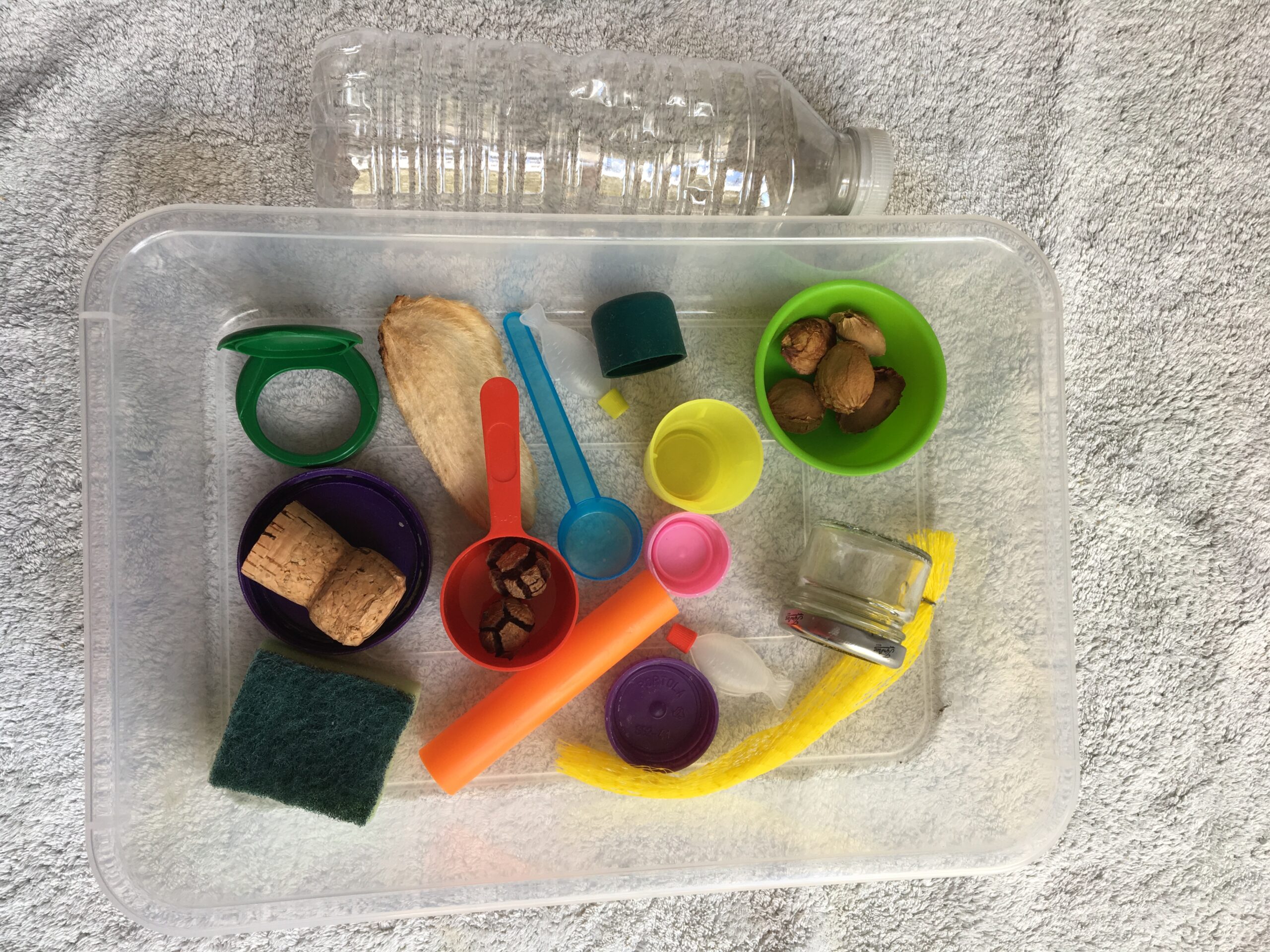
- Towel on the table,
- Water in a CLOSED bottle (which is ONLY ‚served‘ by the adult!)
- a flat tray NOT larger than approximately A4 format
- various SMALL containers
- SMALL ‚hand tools: ladle (e.g. coffee or baby milk powder spoon), various sponges to soak up/squeeze out water, small funnel, small net, tea strainer, ...
- LINE ‚loose parts‘ that can be transported back and forth with a spoon or are otherwise interesting because they float or sink, for example, or that you can do something with.