Building towers out of building blocks is an activity that is often welcomed and considered advanced by adults. But Unfortunately, it is often a developmental dead end, especially for children with autistic-like behavior. Because Children (and adults) who are enthusiastic about building towers tend to get stuck on this idea and often find it difficult to expand their imagination to the many other creative ways in which blocks or other materials can be used and combined in patterns and endless variations.
‚When Franklin when he joined us at kindergarten at the age of 4, it was very difficult for him and for all of us. We couldn't reach him at all. He ran frantically back and forth all the time, spitting in the air. He only had one idea with objects: to stack them into towers and then clap his hands. If anyone got in his way, he would react by scratching and biting and spitting directly into the face of the troublemaker. We really tried everything we could. But in the end we had to put all the toys away to avoid these situations, so now there's nothing left for him to play with and gain new experiences.‘ (Becky, kindergarten teacher)
This example shows that building a tower of building blocks is actually a very limited form of learning, especially for children with developmental delays, autism or autistic-like behaviors. This is because stacking things neatly on top of each other requires relatively few and very precise movements and fine motor skills. However, the child learns very little about the different textures of objects or the many ways in which their arms can move or their hands can grasp.
Instead of thinking ‚What else could I do with these materials?‘ the focus is on a very specific idea and expectation, i.e. completing the tower and the excitement of seeing it topple or collapse, and then repeating the same experience and excitement with as few variations as possible. But this compromises the child's ability to experience, because the focus is on the minimal movement experience of precise stacking and the subsequent senso-emotional excitement, and on keeping the experience as predictable and the same as possible, rather than seeking new experiences about the different properties of different objects through their own exploratory doing.
Examples of 2 development-promoting play options for building
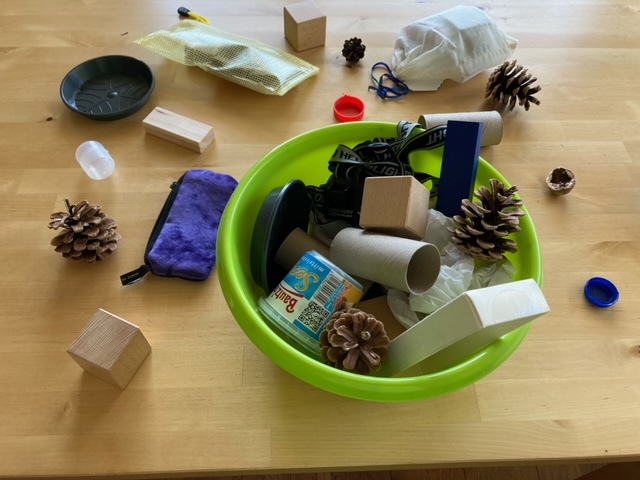
1. pile things on top of each other
The diverse experiences that come with piling things on top of each other are the exact opposite of precise tower building, as they expand the child's basic general understanding of the world and how things behave with endless variations. Each pile will look and behave differently, different things can always come into play and even the base of the pile (bowl, tray, dish) leads to different experiences. With this understanding in mind, it is advisable not to concentrate on building towers with children with developmental delays, or teaching them to do so, but to be guided by the question: ‚What else can be done with these materials? And how varied can they be with other things?‘
2. form rows: build horizontal ‚towers‘
However, if you arrange blocks or other materials in a row, like a kind of horizontal tower, there are endless possibilities for variation in which the child can gain and implement many new experiences. The prerequisites for this are
- enough ‚stuff‘, i.e. several collections of at least 8-10 identical pieces that are stable (at least at the beginning) and do not wobble or easily fall over or roll away, e.g. large and small blocks, rings, corks, muggle stones
- that the learning guide is aware that a child's entire personality development is based on his or her sensory-motor experiences through doing and handling things with his or her own hands, which results in increasing pattern recognition and imagination skills
- Children who have difficulty learning and gaining these fundamental sensory-motor experiences with their own hands need our sensitive guidance and support here
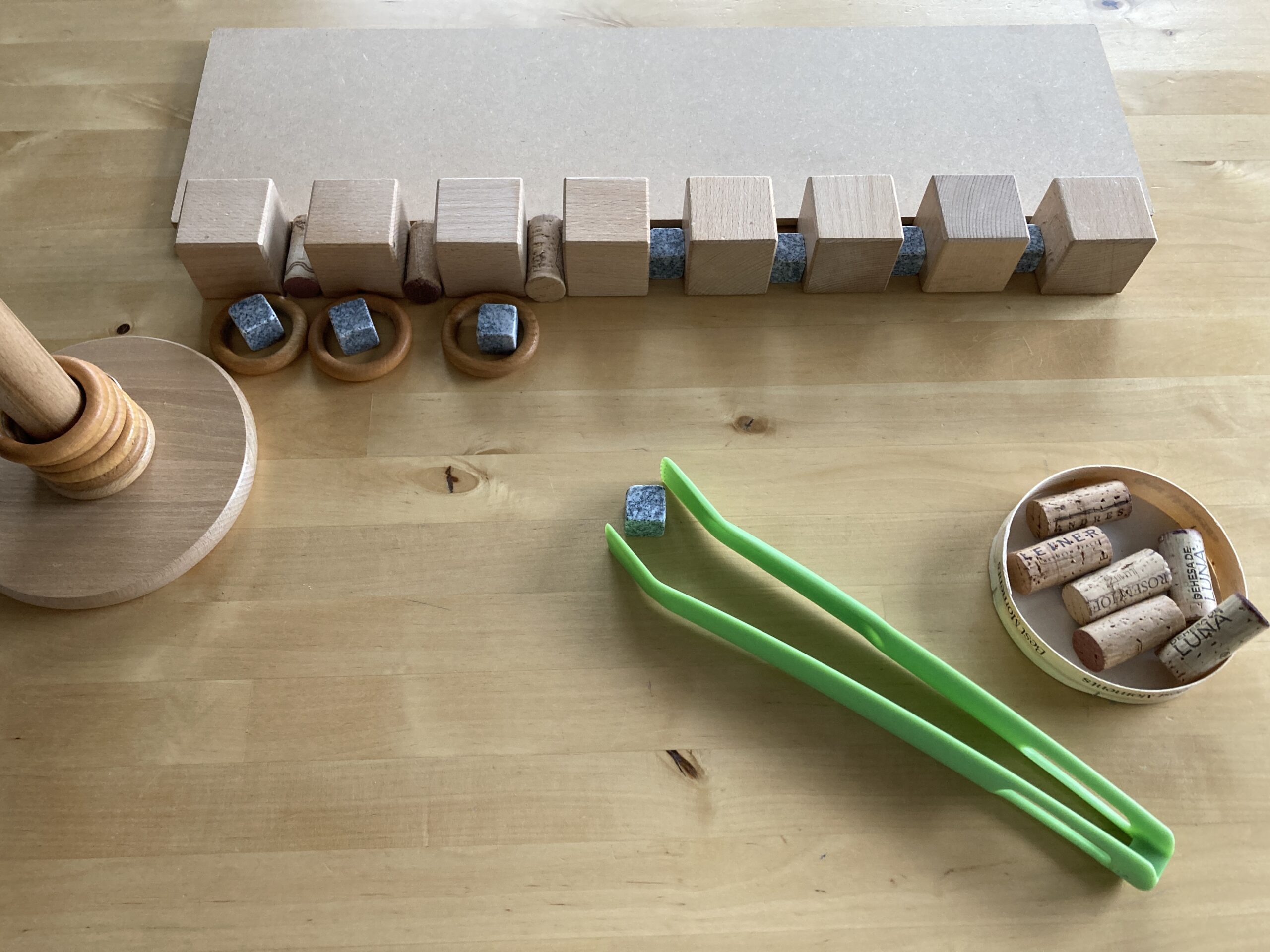
Here is an example of a more advanced activity that shows how several collections can be combined in different ways to form predictable patterns, possibly using a hand-held tool such as spaghetti tongs to practise different grips and add further variations.