We are often confronted with challenging behavior, for example when a child shows very controlling behavior and simply won't stop doing something or insists on doing it. Traditional methods of appealing to the child's mind with rational explanations or demanding obedience, sometimes with the threat of punishment or so-called consequences, rarely lead to the desired success. Why is this the case? Why can't the child simply do as it is told?
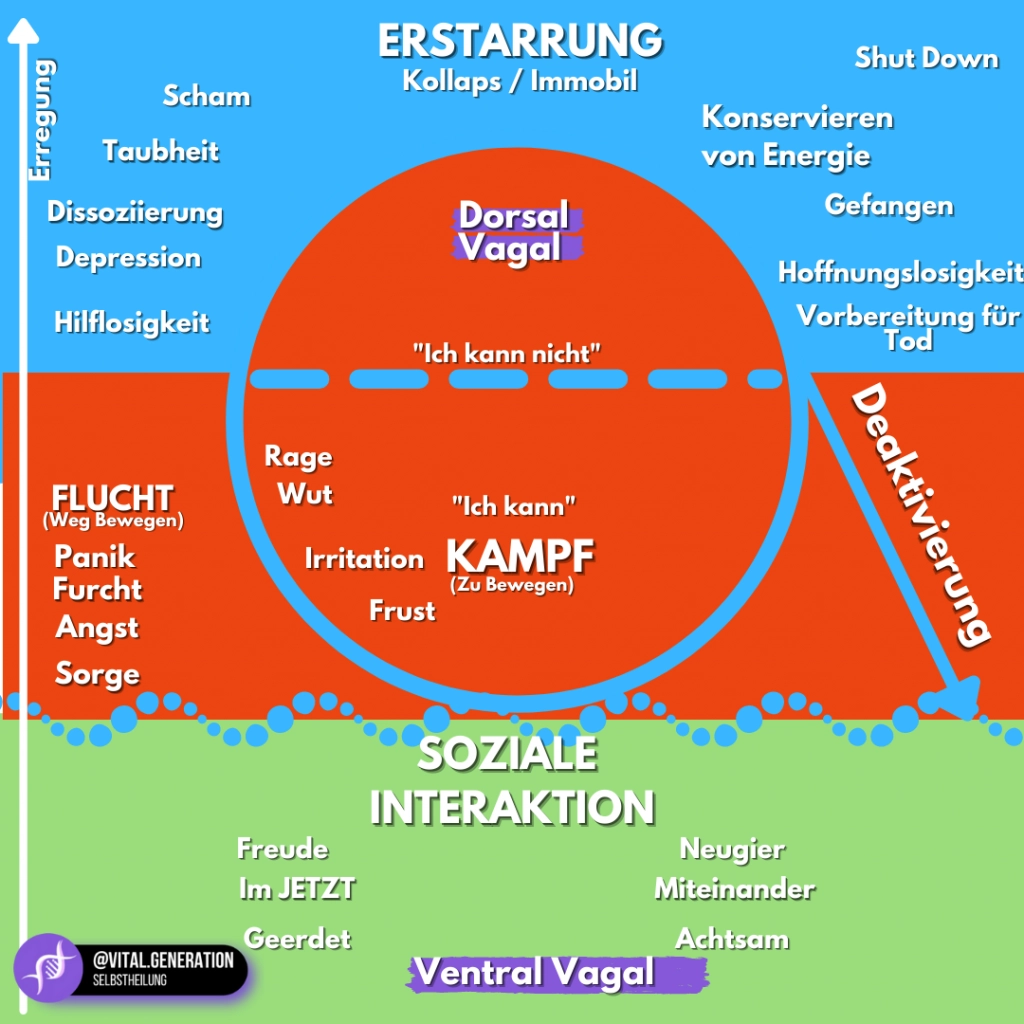
Here, it is helpful to first observe the child’s current physiological state and, in particular, how secure and regulated they feel at that moment—which, for quicker reference, can be briefly summarized as ‚green-red-blue‘:
1. in the green zone the child feels safe and supported by friendly people, connected to the world and open to new discoveries
2. in the red zone If the child feels insecure and somehow threatened, to the point that it needs to protect itself, defend itself, or cling to something—for example, perhaps to controlling behavior, an object, or entrenched habits
3. in the blue area The child feels abandoned and so hopelessly alone that it no longer even tries to reach out to others or make eye contact, because it expects neither support nor understanding from them regarding how terrible it feels, and has withdrawn, given up, and shut itself off.
If the child is in the red or blue zone, all of their energy is directed defensively toward a form of self-defense, which also means that their rational mind is not connected to their actions and thoughts. As soon as the tipping point in the middle is crossed and the child enters a state of stress, the autonomic nervous system (ANS) blocks any change. In this state, learning is not possible—only defensive and self-protective behaviors; that is, the child is physiologically unable to understand or perceive rational explanations or the human voice, except as further attacks on their sense of self and threats to their existence. For the caregiver, this means focusing on co-regulation and empathy—and speaking less, or often best of all, not at all—and in any case avoiding explanations and questions. This is because the child’s cerebrum is not ‚turned on‘ or in processing mode at this time.
The child is not intentionally causing us stress, but IS itself stressed and needs empathetic and co-regulating support from us.
We are aware that the child is not intentionally behaving ’badly‘ to challenge us, but rather that ‚it just happens‘ unconsciously because the child is in a state of dysregulated stress and the child’s autonomic (i.e., unconscious) nervous system is in protective mode. With this understanding, we can then Stress detectives When we feel challenged by behaviors and understand, for example, that controlling behavior means that the child feels insecure and threatened in some way and is trying to protect itself through controlling behavior.
This is where a Reflective check-in, to empathize with where the child and its nervous system and its being-in-the-world are at the moment (and you too, of course) and to think about how we can help it regain a sense of security through co-regulation, so that it suits everyone. But traditional methods such as time-outs, punishments, ‚consequences‘ and conventional disciplinary methods only make the child feel even less safe and either fight back or withdraw.
This insight into the fundamental importance of the human autonomic nervous system is based on the Polyvagal theory by Stephen Porges and represents a major paradigm shift that helps us understand behavior. This is a bidirectional theory of how the body and the brain/mind communicate back and forth with each other. In this process, 80 % of the neural information flows from the body to the brain, and only 20% from the brain to the body. This offers us a new, optimistic organizational principle for understanding autistic-like behaviors and autism in a new light: to understand a behavior, one must first understand the body and human physiological states and respond to them interpersonally through co-regulation.
Stephen Porges‘ innovative research on the autonomic nervous system has shown us how humans have evolved to cope with threats. His Polyvagal Theory shows us that, when faced with a threat or danger, we first turn to our social attachment system to restore a sense of safety (we turn to people we trust). If this does not restore our sense of safety, or if the danger is great and immediate, we activate our fight-or-flight mechanisms. If that does not bring us to safety, it leads to a breakdown of body and mind—we shut down and disconnect. People who repeatedly experience that social engagement does not lead to a sense of safety automatically react with fight/flight or withdrawal/shutting down.
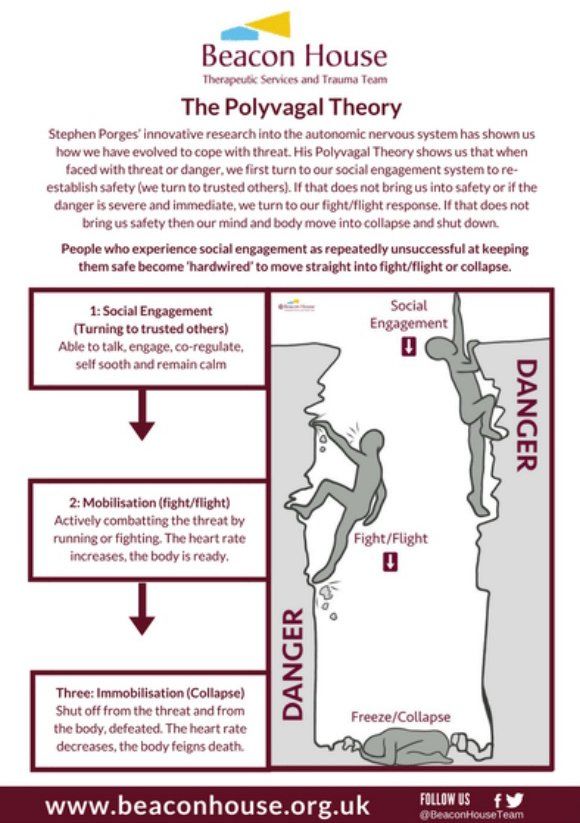
Here is a pictorial representation of these emotional states (with German translation):
1: Socialit commitment (turn to trusted persons): Can talk, form relationships, self-regulate, self-soothe and stay relaxed
2: Mobilization (fight/flight): Actively fight against the threat or flee. Heart rate increases, the body is ready to fight
3. Immobilization (collapse): Withdrawal, disconnected from the threat and from the body, overwhelmed. Heart rate drops, death reflex
a) a reduced social Interaction system
b) EscapeFight (fight-flight) Behavior or
c) Withdrawal, decoupling and Close (freeze/shut-down)
Autistic-like behavior can thus be seen as a stress reaction. In some Children with Autism is the system ‘Fight - Escape - Retreat’ often disturbed in various ways, turns on constantly and unnecessarily, and the child has in the Senses from Physical experience and withdrew into himself. In some so-called ‘Autistic people' was perhaps in the Infancy the Vagal system to the Security system of the Body diverted and remained the Focus of the itself developing Kindes: Perhaps is the child as a baby in one Fight-escape-Solidification Reaction advised and, in this young Age there stuck, because it not knew, like can you get out of it? What, when the Fight-escape-Solidification System to long was on? The toddler can not Learn his social Software to steer, while . T Fight-escape-retreat System on autopilot runs like a ownerless Horse. (Holly Bridges in her book: Reframe your Thinking around Autism).
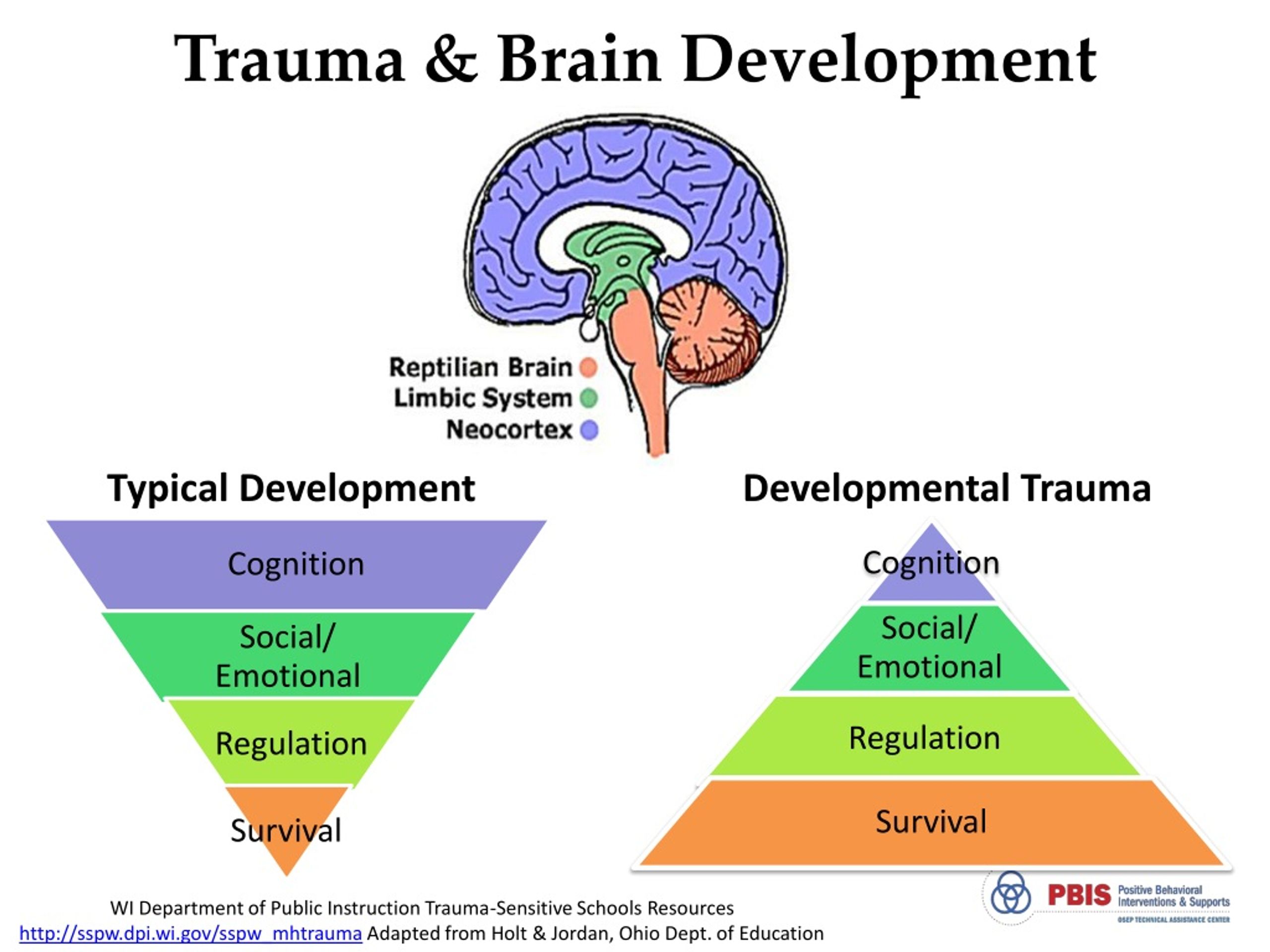
It is important to be aware of how trauma affects a person. Because a traumatized person
- is not able to to filter out, what important and what not important is
- has an imagination that is limited only to what has happened
- is incapable of learning, because he cannot imagine that there are all sorts of other possibilities, including that he too could be successful:
- he's stuck, like in a trap
Trauma knows no development and no connection to the before and after. It is an island.
To better understand challenging behaviors and ‚green-red-blue‘ I recommended the German translation of Mona Delahooke's book ‚Brain-Body Parenting‘.

If you want to know more about the connection between the findings of polyvagal theory and autism, and know a little English, then I can highly recommend the book by Holly Bridges